Project History

Kibale Forest Education Project, Uganda

In 2001, the Kibale Forest Education Project was created by Michael Stern and Rebecca Goldstone to teach local students about the amazing biological wealth of their National anti-litter rally, Kibale, UgandaPark. Over 850 students from five schools participated during the project’s first year, taking day-long trips to experience the forest and meet its inhabitants.   Above: Students enjoying the library at the project’s classroom in the forest.

Since that time, the project has and continues to undergo a remarkable evolution. Under the auspices of the Jane Goodall Institute, Ugandan teacher Margaret Kemigisa expanded the project to include eight schools.  Over 1,000 students were brought to visit Kibale in 2003 and 2004. Although JGI found that it needed to direct its energies elsewhere in late 2004, Ms. Kemigisa continued to educate local citizens about the park.  Working without a salary, she established environmental clubs and organized environmental rallies at local schools and formed a women’s craft cooperative that utilizes sustainable resources from around the park.  Right: An anti-litter rally organized by Ms. Kemigisa.

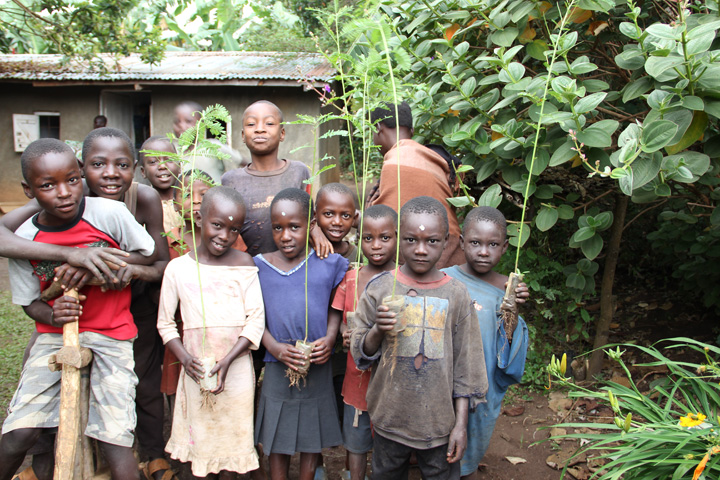
nursery boy, Kibale, UgandaMs. Kemigisa also started seedling nurseries at local schools to teach sustainable methods of growing fuel wood (pictured at left).  Presently, wood and charcoal are the sole sources of energy for 98% of people surrounding Kibale.  This pressing need has shaped the creation of the current project.

Armed with the experience and relationships gained through its development, the Kibale Forest Education Project began a new incarnation as the Kibale Fuel Wood Project.  For its first three years, the project operated under the auspices of the Chimp-n-Sea Wildlife Conservation Fund.  Continuing now as a collaboration between local citizens, the New Nature Foundation and the Uganda Wildlife Authority, the project establishes demonstration tree nurseries and actively promotes home-grown wood.  Through an educational outreach program, the project seeks to enhance appreciation for the National Park while teaching and encouraging the use of environmentally sustainable practices.   As the project’s Manager, Ms. Kemigisa continues her impassioned work.  By creating a legal wood source to satisfy human needs, the project will better protect the natural forest and improve park-people relationships, helping to provide a more secure future for both wildlife and humans.

Kibale Chimp, Uganda